The short answer
ChatGPT often does not stick inside a team because the company has not given it enough context. People try it once, get a generic answer, and go back to the old process. The fix is to give AI the company voice, rules, examples, processes, and a clear job to do.
This is common in small businesses.
A founder buys ChatGPT Team. A few people try it. Someone writes a better email. Someone summarizes a call. Someone asks it to create a sales proposal and gets something that sounds wrong.
Then usage fades.
The tool is still there. The team just stops trusting it.
The problem is rarely the model. The missing piece is company context.
What goes wrong when a team starts with ChatGPT
Most teams start with a simple idea:
"Let's give everyone ChatGPT and see what happens."
That sounds fine. It rarely works for long.
Because people do not work in a blank document. They work inside a messy business:
- old client promises;
- unwritten rules;
- half-documented processes;
- examples from past work;
- Slack threads nobody cleaned up;
- sales calls nobody turned into notes;
- tone that lives in someone's head;
- exceptions that only one person remembers.
ChatGPT does not know any of that by default.
So it gives a clean answer that misses the real business.
It may sound polished. It may even sound smart. But it does not sound like your company. It does not follow your process. It does not know what your team already tried. It does not know which clients need careful handling.
That is where trust breaks.
Tip
The first fix is not a better prompt. The first fix is a small folder of real context: your offer, your tone, three good examples, three bad examples, and the rules a human already follows.
The real issue: AI has no company memory
A useful AI system needs more than a prompt.
It needs company memory.
For a small business, company memory means the practical things your team already knows:
- how you describe your offer;
- how you reply to clients;
- how you write proposals;
- how work moves from request to delivery;
- what good work looks like;
- what bad work looks like;
- what should be checked by a human;
- what should never be sent without approval.
Without that memory, every AI task starts from zero.
One employee writes a great prompt. Another employee uses a weak prompt. A third person gets a bad answer and decides the tool is useless.
Nothing becomes a process.
Why this matters now
AI usage at work is already high, but many companies still struggle to turn usage into real business results.
McKinsey's 2025 workplace AI report found that 92% of companies plan to increase AI investment over the next three years, while only 1% of leaders say their companies are AI mature. McKinsey defines maturity as AI being fully built into workflows and driving real business outcomes.
Microsoft's 2025 Work Trend Index also points to the same gap. The report says scaling AI is an organizational challenge. Technical setup is only one part of the work. The report is based on a survey of 31,000 knowledge workers across 31 countries, LinkedIn labor market data, and Microsoft 365 signals.
Deloitte's 2024 year-end GenAI report puts it simply: organizational change moves slower than the technology. The report found that companies are becoming more practical about AI, with more focus on ROI, risk, governance, and team readiness.
The pattern is clear.
Buying AI is easy. Making it part of real work is harder.
Heads up
If the team cannot explain where AI should help, who checks the result, and what "good" looks like, the tool will become another tab people forget to open.
The five reasons ChatGPT fails inside teams
1. The team has no shared use case
A team cannot adopt AI around a vague goal like "use AI more."
That is too broad.
Pick one repeated task first.
Good first tasks usually look like this:
- the task happens every week;
- the input is easy to collect;
- the expected output is clear;
- one person can check quality;
- mistakes are annoying, not dangerous.
Examples:
- first draft of a customer reply;
- sales call research;
- proposal outline;
- meeting summary;
- turning founder voice notes into draft content;
- turning messy notes into a simple SOP.
Once one process works, the team has proof.
Without that first process, AI stays random.
2. The company voice is not documented
Most teams say they care about voice.
Few have it written down.
That creates a problem. AI cannot copy a voice that only exists in someone's taste.
If your team says, "this does not sound like us," the next question is:
where is "us" written down?
A basic company voice file can be simple:
- words we use;
- words we avoid;
- tone examples;
- before and after examples;
- sample client replies;
- approved sales copy;
- common phrases from the founder or team.
This does not need to be fancy.
It needs to be clear enough that AI can follow it and a human can check it.
3. Processes live in people's heads
AI works best when the process is visible.
That does not mean you need a giant operations manual. It means the key steps should be written down.
For example, a support reply process might include:
- Read the full customer message.
- Identify the product, account type, and request.
- Check if this is billing, technical, emotional, or urgent.
- Use the approved tone.
- Mention the next step clearly.
- Escalate if the case matches a risk rule.
If these steps are not written down, AI guesses.
When AI guesses, the team stops trusting it.
4. Nobody owns the AI workflow
A team needs one owner for the first AI process.
This person does not need to be technical. They need to care about the process and know what good output looks like.
The owner checks:
- are people using it;
- where does it fail;
- what examples should be added;
- what rules are missing;
- what should be changed next week.
Without an owner, AI becomes everyone's idea and nobody's responsibility.
That usually dies quietly.
Tip
Pick the owner from the team that lives with the process. For support, that is usually a support lead. For proposals, it is sales or the founder. The best owner is the person who can tell in five minutes whether the output is usable.
5. The team expects magic from a blank chat box
A blank chat box puts too much work on the employee.
They need to know what to ask. They need to write the prompt. They need to judge the answer. They need to fix mistakes. They need to remember the process next time.
That is too much friction.
A better setup gives the team a ready workflow:
- use this input;
- run this prompt;
- check these points;
- paste the output here;
- send to this person if unsure.
The goal is not to make everyone a prompt engineer.
The goal is to make one useful process easier than doing it manually.
What a company AI brain means in practice
A company AI brain is a simple working base of company context that AI can use when helping your team.
It can include:
- company overview;
- offer and positioning;
- customer profiles;
- tone of voice;
- writing examples;
- sales examples;
- support rules;
- delivery process;
- meeting notes;
- SOPs;
- approval rules;
- common mistakes;
- examples of good and bad output.
This is not a knowledge base for show.
It is the foundation that lets AI answer like it understands the business.
For a small team, the first version can be built in a week. It should start with the process you want to improve first. Do not document the whole company before you ship anything.
Start with the smallest useful version.
How to make ChatGPT useful inside a team
Use this order.
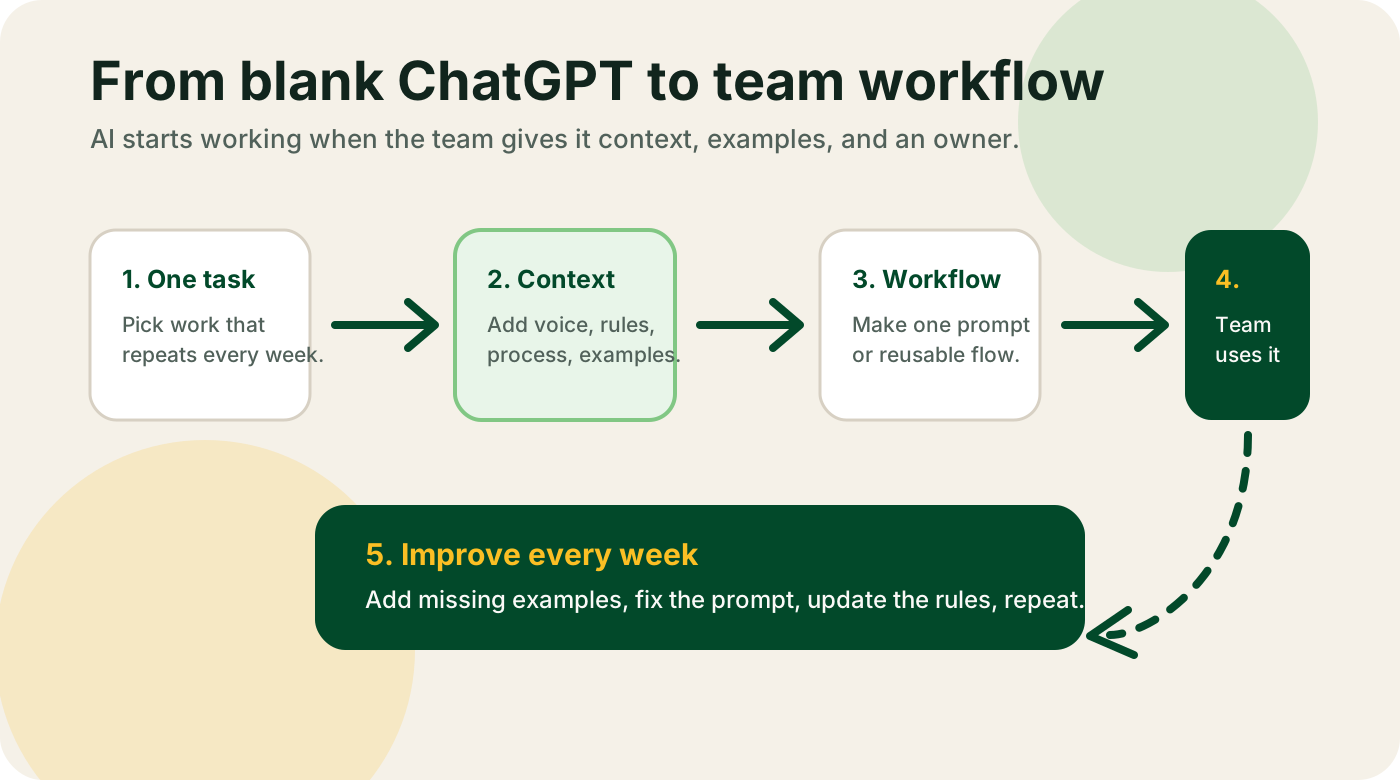
Step 1: Pick one painful repeated process
Choose one task that wastes time every week.
Do not start with the most complex process in the company. Start with a task where the team can check quality quickly.
Good options:
- customer reply drafts;
- sales proposal drafts;
- call summaries;
- research before sales calls;
- content drafts from voice notes;
- internal SOP drafts.
Step 2: Collect five real examples
AI needs examples.
Collect:
- two examples of good output;
- two examples of weak output;
- one edge case where the team must be careful.
This gives AI a better target than a vague instruction like "write in our style."
Step 3: Write the process in plain language
Write the steps as if you were training a new teammate.
Keep it short.
Use this format:
- What comes in.
- What AI should create.
- What rules it must follow.
- What a human must check.
- What happens after approval.
Step 4: Build one reusable prompt or workflow
Turn the process into one reusable workflow.
This can be a saved prompt, a project inside ChatGPT or Claude, a simple automation, or a custom internal page.
The format matters less than repeatability.
If the team has to reinvent the task every time, it will fade.
Info
A reusable workflow can be simple. One saved prompt, one checklist, and one example output is enough for a first version. Build the habit before you build the system.
Step 5: Test with real work for one week
Use it on real tasks.
Track simple numbers:
- how many times was it used;
- how much time did it save;
- where did it fail;
- what did the human need to fix;
- did the final output get used.
At the end of the week, improve the workflow.
Small fixes beat a giant reset.
Simple scoring matrix: is this process ready for AI?
Use this before choosing the first AI process.
Score each item from 1 to 5.
| Question | Score |
|---|---|
| Does the task repeat every week? | 1-5 |
| Is the input easy to collect? | 1-5 |
| Is the desired output clear? | 1-5 |
| Are there few dangerous edge cases? | 1-5 |
| Can one person check quality? | 1-5 |
| Does the task waste enough time to matter? | 1-5 |
20+ points: good first AI process.
15-19 points: possible, but needs a clearer process first.
Under 15 points: probably too messy for the first pilot.
This scoring is simple on purpose. If a team cannot score the process in ten minutes, the process is probably not ready.
A practical example
Let's say a small consulting team wants to use ChatGPT for sales proposals.
The weak version looks like this:
"Write a proposal for this client."
The output sounds generic. The founder edits everything. The team decides AI is not useful.
The better version gives AI the real business context:
- who the client is;
- what was discussed on the call;
- what the client cares about;
- the approved offer structure;
- the company's tone;
- past proposal examples;
- pricing rules;
- what claims cannot be made;
- what the human must approve before sending.
Now AI can create a usable first draft.
The founder still reviews it. But the work starts at 70%, not at zero.
That is the real win.
What to avoid
Avoid these common traps:
- buying more AI tools before fixing the process;
- asking every employee to invent their own prompts;
- starting with a risky workflow where mistakes are expensive;
- building a giant internal wiki before testing one use case;
- measuring AI by excitement instead of saved time;
- making the most technical person own a business process they do not run.
A small team does not need a huge AI program.
It needs one clear process, one owner, and enough company context for AI to be useful.
The bottom line
ChatGPT does not stick inside teams when it stays a blank chat box.
It starts working when the team gives it a job, a process, examples, company voice, and a human owner.
If your team tried AI and it faded after a week, do not start by buying another tool.
Start by asking:
where does the team lose time every week, and what context would AI need to help with that task?
That question usually points to the first useful pilot.
FAQ
Why does ChatGPT give generic answers at work?
ChatGPT gives generic answers when it does not have enough company context. It needs your offer, tone, examples, process, rules, and customer details to create work that feels specific to your business.
Should every employee use ChatGPT in their own way?
Personal use is fine for learning, but business use needs shared workflows. If every employee uses AI differently, quality will vary and the team will not build a repeatable process.
What is the best first AI use case for a small team?
The best first AI use case is a repeated task with clear input, clear output, and easy human review. Good examples include customer reply drafts, sales proposal drafts, call summaries, research before sales calls, and internal SOP drafts.
Do we need a technical person to make ChatGPT work inside the team?
Not for the first useful process. You need a process owner who knows the work and can judge quality. Technical help becomes useful later if you want integrations, automations, permissions, or a custom tool.
What is a company AI brain?
A company AI brain is a simple base of company context for AI. It can include your offer, customer profiles, tone of voice, examples, SOPs, approval rules, and common mistakes. It helps AI produce work that matches the business.
Want to find the first AI process for your team?
I help small teams find where AI can save real time, build the company context, and launch the first working pilot in two weeks.
Book an AI audit: bdzhel@gmail.com