For two years, every sales tool vendor told you AI would fix outbound. Subscribe to their platform, point it at a list, and watch the pipeline fill up. Most people who tried it walked away with a bigger invoice and the same 1% reply rate.
The teams getting real results in 2026 are not buying more SaaS. They are building small, custom systems -- mostly with Claude -- that replace five disconnected tools with one intelligent workflow. Here is what those systems look like and how to build one.
Why the old stack breaks
The typical outbound stack looks like this: Apollo or ZoomInfo for the list, Clay for enrichment, a copywriting tool for the email, a scoring spreadsheet in Airtable or Sheets, and Instantly or Smartlead to send it. Five tools, five logins, five places for data to go stale.
None of them talk to each other well. When a lead moves from "researched" to "sequenced," context gets lost. The enrichment you spent 20 minutes on doesn't make it into the copy. The copy doesn't reflect the scoring logic. And none of it updates when a prospect changes jobs or their company raises a round.
The manual overhead of connecting these tools often exceeds the time the tools are supposed to save. This is why a r/b2b_sales thread from April 2026 -- posted by someone who stripped their stack down to four tools after "a brutal Q4" -- got hundreds of upvotes. The top comment: "Most of it is expensive noise that creates more manual work than it saves."
What changes with Claude
Claude is not a better copywriting tool. That framing is too small.
The shift is architectural. Claude -- especially through Claude Code or via MCP integrations -- can hold the entire outbound workflow in one place: lead list, scoring logic, copy frameworks, enrichment instructions, and the API calls to push campaigns into your sequencer. It remembers the context from one step to the next. It can rewrite the scoring logic when you change the ICP. It can generate 50 personalized emails without losing the thread of who each person is.
Gojiberry's framing from their April 2026 tutorial is accurate: most outbound teams run "lead scraping on one platform, enrichment somewhere else, signals missed, outreach sent in a third tool." Claude collapses this. Not because it's a single SaaS product, but because it's a general-purpose intelligence that can handle each step -- and hand off between them without losing context.
Two paths to building it
The Claude Code path
Growth Band published a breakdown in April 2026 of a system they built entirely inside Claude Code that generated 2,000+ MQLs in 4.5 months for clients. The core argument: stop running cold email campaigns that die at 1% reply rate. Build a system that handles the intelligence, not just the sending.
The Claude Code approach looks like this: write a scraper to pull leads from your sources, write enrichment logic to score them against your ICP, generate copy using structured prompts, and call the Instantly or Smartlead API to push the campaign. Claude Code keeps everything in one workspace. When the ICP changes, you change one file and regenerate the copy. When a new signal source becomes available, you add it.
This path requires some comfort with code. Not engineering-level, but you need to be able to read a Python script and understand what it does.
The no-code MCP path
Amplemarket released a Claude MCP integration that lets you run every sourcing workflow through an AI agent in natural language. Their claim: a full morning of prospecting compressed into 90 seconds, no weak fits added to the list. Zero coding required -- you connect the MCP server to Claude and write a plain-English prompt.
Gojiberry's LinkedIn MCP works the same way. You describe the type of prospect, Claude pulls matching profiles via the MCP, enriches them, and drafts outreach. The whole thing runs inside the Claude chat interface.
n8n workflows are the third no-code option. A popular stack: n8n + Claude + Explorium. You describe your ICP in plain English, the workflow finds prospects, enriches their data, researches each one, and creates personalized email drafts -- all automated. The n8n template for this is publicly available.
If you are a founder or sales lead who does not write code, the MCP path is where to start.
The prompt formula that actually works
Most people using Claude for outreach are using it wrong. They write a vague prompt -- "write me a cold email to SaaS founders about my product" -- and get generic output that sounds like AI. Then they blame the tool.
The formula that gets results, per Cleverly's analysis of high-performing outreach systems built on Claude:
ICP + defined offer + tight constraints.
The ICP defines who you are writing to: title, company stage, pain point, what they care about. The offer defines what you are giving them and why it matters to them specifically. The constraints are the part most people skip: word limit (typically 60-80 words for the body), forbidden phrases ("I wanted to reach out," "quick question," "hope this finds you well"), and CTA format (one specific ask, not three options).
Without constraints, Claude over-writes. The email gets longer, more hedged, and more generic with every iteration. Constraints force it to make the same choices a good copywriter would make: cut the hedge, sharpen the ask, drop the throat-clearing.
Tip
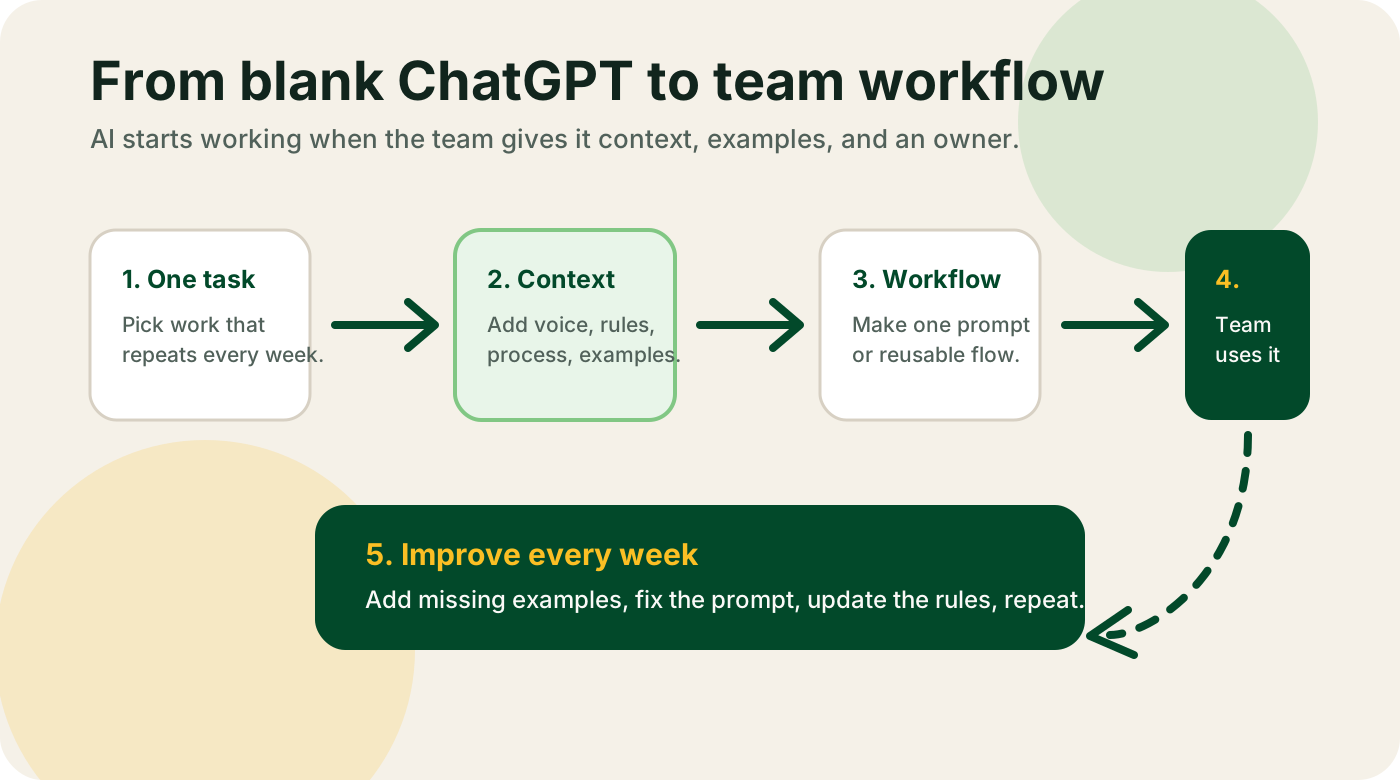
Write your ICP, offer, and constraints once as a system prompt in a Claude Project. Every email you generate after that inherits the full context -- company, persona, tone, forbidden phrases -- without you repeating it. This is what "Claude remembers the context" actually means in practice.
Signal-based beats cold every time
The teams seeing 5-7x higher reply rates are not writing better cold emails. They have changed what triggers the outreach.
Cold list email says: here is a list of 500 people who match our ICP, send them all the same message. Signal-based says: here is a person who just did something that means they are likely in-market right now -- a job change, a fundraise, a public question about a problem you solve, a competitor churning -- send them something specific to that moment.
Clearcue's Claude Code workflow builds this architecture explicitly: detect the buying signal automatically, qualify the prospect in real time, generate outreach personalized to the signal. The personalization is not "Hi {first_name}" -- it is "I saw you just raised a Series A and hired a Head of Sales. Here is what companies in your position usually get wrong with outbound in the first 90 days."
The signal sources that are working right now: LinkedIn job changes, funding announcements via Crunchbase, G2 review activity (someone reviewing a competitor is actively evaluating their category), and public Reddit or LinkedIn posts about problems you solve.
Clay + Claude -- the stack most teams end up on
For teams doing serious volume, the combination that keeps coming up across Reddit and practitioner blogs is Clay for data enrichment and Claude for copy and qualification logic.
Clay handles the hard part of outbound data: waterfall enrichment (finding emails by trying multiple providers in sequence), intent signals, job change tracking, and company data normalization. Claude handles what Clay cannot do well -- synthesizing the enrichment data into a coherent read on whether this person fits your ICP, and then writing copy that reflects that read.
The typical flow: Clay builds and enriches the list, exports to a CSV or pushes to a webhook, Claude scores each prospect against the ICP and generates a personalized first line and email body, Instantly or Smartlead receives the final output via API.
This stack costs roughly $200-500 a month to run, depending on volume and which Clay tier you are on.
What to watch for
Not everything that calls itself AI outbound is worth the invoice. A few things to be skeptical of:
Volume plays dressed as personalization. Some tools generate "personalized" emails by doing a simple LinkedIn scrape and inserting one sentence from someone's bio. This is not personalization. Actual personalization is about relevance to a buying moment, not relevance to a profile.
AI SDR platforms promising hands-off pipeline. The platforms that claim to replace your SDR team entirely -- fully automated outreach from signal to booked meeting -- are mostly not delivering. The teams getting results are using AI to make their existing process faster, not to remove humans from the loop.
Generic prompts generating generic emails. If you put Claude in front of your team without training them on the ICP + offer + constraints formula, you will get mediocre output and your team will conclude that AI does not work for outbound. The tool is not the problem.
If you are building an outbound system and want a second opinion on the architecture -- which stack makes sense for your team size, what the realistic first 30 days look like, and where the common setup mistakes are -- that is the kind of work I do. Book a strategy call and we can walk through it.
Related: AI Marketing Consulting -- What It Is and Who Needs It · AI Integration Consulting -- What the Engagement Actually Looks Like