Most marketing teams at small businesses don't need an "AI marketing strategy." They need one hour a week of their content lead back, one hour of their sales lead back, and one hour of their founder back. AI marketing consulting, when it's done well, is just the fastest way to find where those hours are hiding.
This post is the plain version. What AI marketing consulting delivers, which workflows pay for themselves inside 30 days, how much it should cost, and the five things to watch for when an "AI marketing agency" lands in your inbox with a 40-slide deck.
What AI marketing consulting is
It's a short engagement where an outside operator looks at how your marketing team spends their week, picks two or three workflows where AI can do the boring part, writes the prompts, sets up the tools, and gets at least one of them running before they leave. That's it. No "content transformation." No "marketing intelligence platform." No AI strategy workshop for 15 people.
The workflows that fit are boring on purpose. Weekly content drafts. First pass on email campaigns. Lead research. Competitive scans. Social post rewrites for three platforms. Ad copy variants. These are the things that eat a marketing team's week every week without a good reason. AI cuts them down to the interesting 20%.
The ones that don't fit are the ambitious ones. Brand positioning. Messaging strategy. Creative campaign concepts. Anything where the output has to be surprising is a bad AI job. Save that work for the humans -- they're still far better at it, and the AI will make it feel generic anyway.
A good AI marketing consulting engagement sounds like this in week two:
"We built a Claude workflow that drafts the weekly newsletter from your meeting transcripts and last week's product updates. Sara runs it every Monday in 15 minutes instead of two hours. We also set up Clay to enrich your inbound leads and auto-draft the first-touch email, which cuts 40 minutes off your sales lead's morning. That's 9 hours a week freed up across the marketing team. Here's the playbook."
That's the deliverable. Nine hours a week for a 5-person marketing team is a 22% time win. Over three months, that's roughly one full-time person's worth of capacity unlocked -- without a hire.
The three workflows that pay for themselves in 30 days
I've run enough engagements now to see the same three winners come up over and over. Pick any one of these for the first pilot and you'll break even on advisor fees inside the first month.
Workflow 1: Weekly content drafts. Your team probably writes one newsletter, one blog post, or one LinkedIn update every week. That's a 3-6 hour task per person, most of which is the first draft. A system prompt with your brand voice, your positioning doc, and three examples of past great posts will get you to a 70% first draft in 8 minutes. The human edits for the remaining 30%. Total time drops to 30-45 minutes.
Workflow 2: First-touch outbound email. For any inbound lead, an SDR or sales lead spends 10-15 minutes researching the company and drafting the first outreach. Multiply that by 40 leads a week and you're at 8 hours just to say hello. Clay plus a good system prompt will do the research and write the draft in under a minute per lead. Your lead just reviews, tweaks, sends.
Workflow 3: Competitive scan. Most small marketing teams run a "what are competitors doing" sweep manually every few weeks -- landing page changes, new pricing, recent blog posts, ad copy shifts. Claude with browsing plus a simple checklist prompt cuts a 4-hour manual scan to 20 minutes, with better coverage. Run it monthly. Drop the notes in a shared doc. Use them in your next planning meeting.
Any of the three will save real hours if you ship it. All three together -- which is the normal shape of a 2-week engagement -- typically saves 10-15 hours a week across a small marketing team.
Who needs AI marketing consulting
The people who benefit most are smaller than you'd expect.
Perfect fit:
- Teams of 3 to 15 marketing people
- One content-heavy weekly or biweekly deliverable that currently eats 3+ hours
- At least one person on the team who already uses Claude or ChatGPT casually
- A founder or head of marketing who can say yes to a pilot without a committee
- Monthly tool budget between $100 and $500
Okay fit:
- Solo marketers or founder-led marketing with 5+ hours of writing per week
- Agencies looking to deliver more client work per head
- B2B SaaS marketing teams in the 5-30 person range
Bad fit:
- Enterprise marketing (you need a different kind of engagement -- data governance, procurement, and compliance take over the project shape)
- Teams with no current marketing output (AI won't fix a missing strategy)
- Agencies that want to "sell AI services" without using AI internally first
- Anyone trying to replace a marketing team with AI (doesn't work, won't work, move on)
If you're in the perfect fit bucket, the ROI math is hard to beat. A single 2-week engagement at $5K-$8K typically returns that within 60-90 days through time savings alone, and keeps returning it every month after.
What a good engagement looks like, week by week
Since this is how I run it, the shape is consistent.
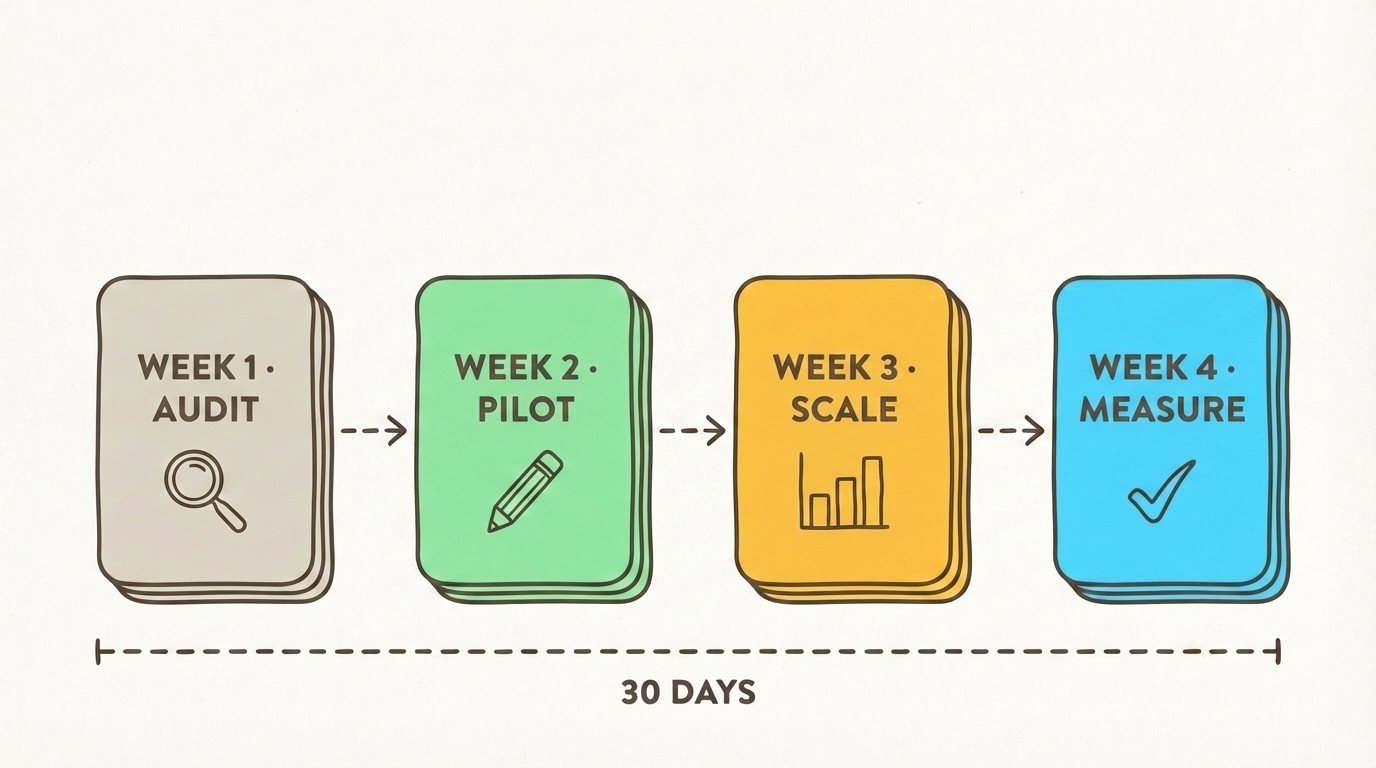
Week 1: audit and pick. Two calls under an hour each. I ask how your marketing engine runs, who does what, and what hurts most. Then I shadow the tools -- your current content doc, your email platform, your CRM, your analytics. By the end of week one I have a list of 8-10 AI opportunities scored by "hours saved per week" and "time to set up." The top 1-3 become the pilots.
Week 2: build the pilot. We pick one workflow -- usually the weekly content draft, because it's the most universal -- and I write the system prompt, set up the account, and run it against 5 real tasks from the past month. Something breaks. We fix it. Something else breaks. We fix that. By Friday the owner on your team runs it in front of me, and I make sure they can do it without my help.
Days 11-14: handoff. I write up the playbook, the prompts, the tool setup, and a 30-day plan for the two workflows we didn't ship. One Loom walkthrough of the live pilot. Then I'm gone. If something breaks in the first 30 days, I come back for free to fix it.
Total time for your team: about 6 hours of meetings and 4-6 hours for the pilot owner to learn and run the new workflow. Total calendar time: 2 weeks. Cost: usually $5K-$8K fixed.
The tools worth paying for
Small marketing teams don't need 20 AI tools. They need 3 or 4 good ones with clear owners.
Claude Pro ($20/month). The core writing tool for anything long-form. Better than ChatGPT at following brand voice over long documents. 200k context window means you can paste your whole content library plus your positioning doc and it still knows what it's doing on draft 12. Buy one seat for the content owner to start.
Perplexity Pro ($20/month). Replaces Google for research. Its Deep Research mode (added in 2025) is what a marketing intern would take half a day to do -- in four minutes. Use it for competitive scans, trend research, and first-pass lead research.
Clay (~$150-$350/month depending on volume). The hands-down best tool for enriching leads and personalizing the first line of outreach. If you do any B2B outbound at all, this is usually the tool that delivers the biggest absolute time savings in an engagement.
Ideogram ($20/month). Only image model that reliably generates readable text inside images. Matters for social cards, ad creative, and anything where the visual needs to carry a headline.
Zapier or n8n ($0-$50/month). The glue. Use it to pipe data from your CRM to Claude and back. n8n if you have a technical person and want to self-host. Zapier if you don't.
Total stack: around $200-$500/month for a small marketing team. That's less than one freelance writer's hourly rate for a full month of tools.
Everything else -- Jasper, Copy.ai, Writer, marketing.ai, and the 20 other AI "marketing platforms" you've seen on LinkedIn -- wraps GPT-4 in a nicer UI and charges you 3x for the privilege. In 2026, you don't need them. One system prompt with Claude or ChatGPT does the same job.
Five red flags in an AI marketing agency pitch
I've seen enough bad pitches from agencies rebranded as "AI marketing firms" to be confident in these patterns.
1. They sell "AI content at scale" as the main deliverable. Mass-produced AI content is how small businesses tank their SEO rankings in 2025-2026. Google's spam team built tools specifically for this and they work. If an agency promises to publish 50 AI blog posts a month, they're building your ticket to a manual action.
2. They can't name which model they use and why. A real advisor will say "we use Claude Sonnet for content, Perplexity for research, and GPT-4o for image descriptions because X." A marketing agency pretending to be AI-native will say "we use AI." That difference tells you the whole story.
3. They won't set up anything on your accounts. Good engagements mean the advisor logs into your Claude workspace, writes the system prompt, saves it somewhere your team can edit. Bad ones hand you a 40-page "prompt library" PDF and leave. Ask directly: "will you configure this on our accounts or just give us recommendations?" If the answer is "just recommendations" -- it's a report, not an engagement.
4. They bundle AI with generic services. "AI marketing strategy" next to "brand workshops, SEO audit, paid ads management, and influencer outreach" on the same pitch deck is an agency that put the word AI in front of their 2019 services list. You want someone who does only the AI part, because that's the only way they're good at it.
5. The price is per month, not per engagement. AI marketing work is mostly front-loaded: pick workflows, write prompts, set up tools, train one person. After that, maintenance is hours per month, not days. A $5K/month recurring "AI marketing retainer" is how agencies book steady revenue for doing what was a one-time job. Prefer a fixed-fee 2-week engagement followed by an optional $1-2K/month office-hours retainer if you want someone on call.
DIY vs hiring an AI marketing consultant
Honest version.
Do it yourself if:
- You're a founder or solo marketer who already uses Claude or ChatGPT every day
- You have one clear workflow you want to fix (weekly content, outbound, or research)
- You have 8-10 hours of weekend time to write and test prompts
- Your tool budget is under $100/month
Start with my post on how to implement AI in your business, grab the free AI starter kit with 35 prompts, and run the four-phase loop yourself. Pick one workflow. Write one system prompt. Ship it. You'll get 70% of what an advisor would deliver in 4-6 weekends of focused work.
Hire an AI marketing consultant if:
- You have 5-15 people on the marketing team and nothing has stuck
- You've already tried 3 AI tools and the team bounced off all of them
- You want someone to tell the team what to stop doing (sometimes the hardest job)
- You have $5K-$8K for one project and want it done and working inside 2 weeks
- You want a written playbook to hand the next marketing hire
A good advisor at $5K for a 2-week engagement will typically pay back the fee inside the first 60 days through time savings alone. After that, the ROI is linear -- every month you keep running the pilot is pure upside.
How to structure the first call with any AI marketing consultant
Regardless of who you end up hiring, ask these six questions on the first 30-minute call. The answers will tell you everything.
- Which three workflows on my team would you tackle first, based on what you already know about our business? If they can't answer without a 3-week discovery, they're stalling.
- Which tools would you use for each? A real advisor has opinions. A fake one hedges.
- What's the fixed price for a 2-week engagement like this? No real range means no real package.
- What breaks the most on the workflows you're recommending, and how do you handle it? This separates people who've shipped AI workflows from people who've only read about them.
- Will you set it up on our accounts or hand us a report? Deal breaker if it's just a report.
- What's your 30-day fix guarantee if something stops working? Good advisors have one. Agencies don't.
If you get clear answers to all six in under 30 minutes, you're talking to someone who does this for real. If you get vague answers to three or more, keep looking.
The 30-day starter plan
Don't wait for a consultant to do this. Run this yourself this month.
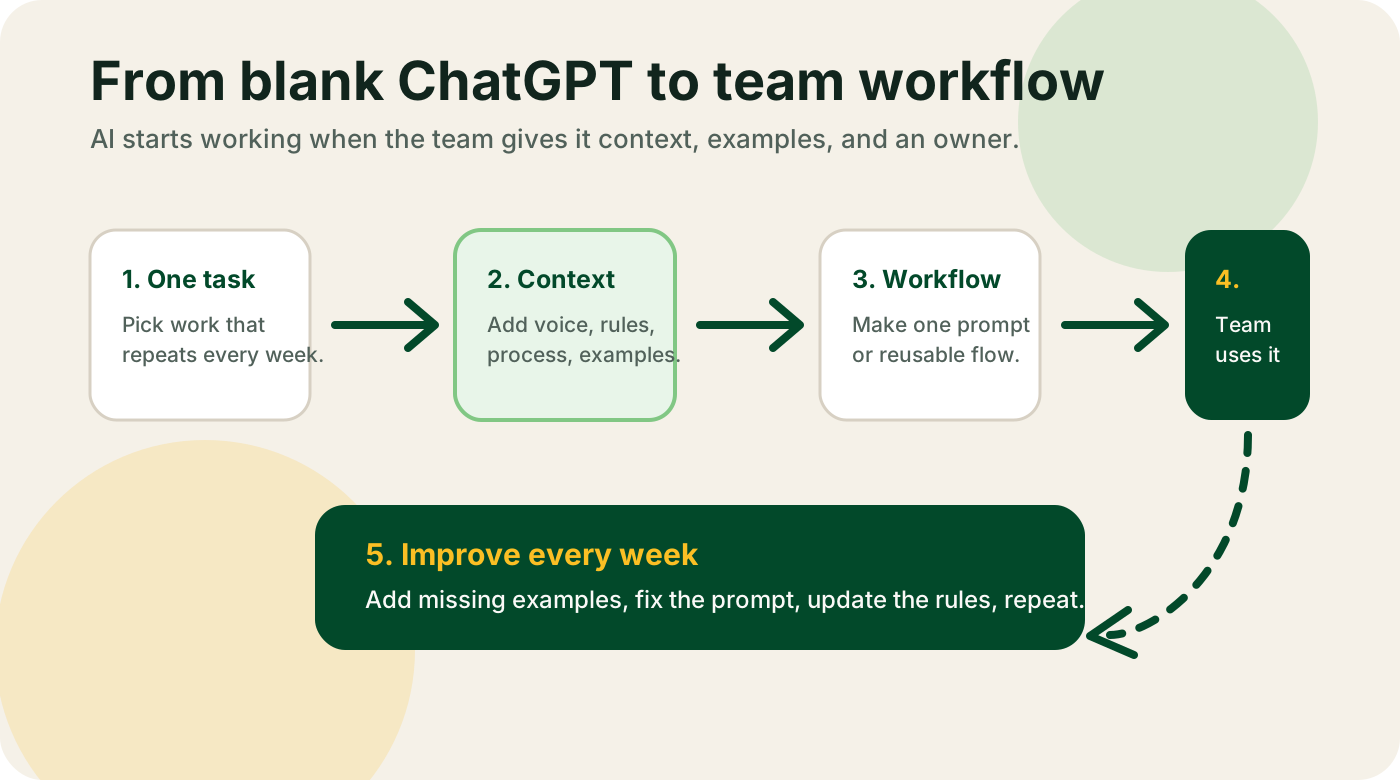
Week 1. Pick your single most painful marketing workflow. Not the biggest. The most repetitive. Weekly newsletter, outbound email, lead research, or competitive scan. Write down who owns it and how long it takes each week.
Week 2. Spend 4 hours writing a good system prompt for that workflow in Claude Pro or ChatGPT Plus. Include your brand voice, one real past example, and specific format instructions. Run it against 3 real tasks from last week. Compare output to what you shipped. Note what's better and what's worse.
Week 3. Fix the prompt. Usually this means adding more examples, tightening the format instructions, or restricting the model from making things up ("do not invent numbers -- write '(data needed)' if something is missing"). Run it against 3 more tasks.
Week 4. Ship it. The owner now runs the AI version of the workflow for one full week. Track how long it takes compared to before. If it saves 30% or more of the time and the quality is the same or better, you just shipped your first AI marketing pilot. Do the next workflow.
If you run this plan for three months in a row, you'll have three working AI workflows and somewhere between 12 and 25 hours a week freed up across the team. That's the whole game.
Getting help
If the 30-day plan feels like too much work and you'd rather have someone run the first loop with you, book a 2-week AI audit. I'll do the discovery, pick the right workflow, build the pilot, train the owner, and leave you with a playbook for the next three.
You can also read:
- AI consulting for small businesses -- the general version of this post, covering all consulting (not just marketing)
- AI strategy consulting: when you need it and when you don't -- for teams trying to decide if they need a strategy layer first
- How to implement AI in your business -- the four-phase framework, DIY version
- The best AI tools for small business in 2026 -- honest picks across every category
The best AI marketing consulting isn't a transformation project. It's someone from outside your team with strong opinions, a working knowledge of the tools, and the discipline to ship one thing in two weeks. That's the whole trick, and once you've seen it work, you won't buy the 40-slide version again.