"AI strategy consulting" is one of the most abused phrases in B2B services right now. Some of the engagements I watch from the sidelines are genuinely great -- 10-40 person companies getting unstuck in two weeks and running their first real AI workflow by week three. Others are $80,000 slideware contracts that produce a 60-page "AI maturity roadmap" the client never reads.
Both are sold under the same name. This post is how to tell them apart.
I'll walk through what AI strategy consulting delivers when it works, the three tests that tell you whether you need it, what it should cost, what a real strategy document looks like, and how to spot the vendors selling you a feeling instead of a plan.
What AI strategy consulting is
It's an outside operator who spends 1-3 weeks looking at your business and answers three questions:
- What to do with AI. Which workflows, in what order, with what tools.
- What not to do. Which trendy AI projects are a waste of time for your specific company.
- How fast to move. The realistic 90-day, 6-month, and 12-month horizon for someone your size.
The deliverable is a short written document, a ranked opportunity list, and a recommended first pilot you can ship within two weeks of the engagement ending. That's it. If the output is longer than 10 pages, someone billed you for pages.
The name "strategy" confuses people because they associate it with something that takes months to produce. Real AI strategy for a small or mid-size business is the opposite -- it's short and opinionated because the only way to be useful is to cut options. The work of a strategist is saying "not these eight things, these two." Anything else is just a catalog.
A real AI strategy for a 40-person SaaS company reads like this:
"Based on your team shape and current workflows, the three AI projects with the highest ROI in the next 90 days are: (1) auto-draft of weekly customer success reports, (2) Clay-based enrichment for inbound leads, (3) Claude-based support triage for tier-1 tickets. Not recommended in this phase: autonomous AI agents, multi-tool orchestration platforms, anything requiring custom model training. First pilot to ship in week three: project (1). Budget: $150/month additional. Expected time savings by day 90: 12-18 hours per week across the team."
Two paragraphs. Three recommendations. One first pilot. One budget number. Everything else is commentary.
The three tests: do you need AI strategy consulting?
Most small businesses don't. These three tests tell you for sure.
Test 1: Can you name the three workflows you'd pilot first?
Answer yes or no, right now.
If yes -- you don't need a strategy consultant. You need to implement one of them. Book a 2-week implementation engagement if you want help with execution. Skip strategy, go straight to build.
If no -- you might need a strategy consultant. But keep reading, because it might also be something else.
Test 2: Have you already tried and failed?
If your team has bought 2-4 AI tools in the last year and none of them stuck, the problem is almost never strategic. It's execution. You rolled something out without an owner, trained everyone instead of one person, or skipped the prompt engineering step.
Fix those execution issues first. A strategy consultant won't help you if execution is broken -- they'll give you a new list, you'll fail to execute on that one too, and you'll blame the consultant instead of the real problem.
Where strategy helps: when you haven't tried anything yet and you're afraid to spend the money on the wrong thing.
Where implementation help is what you need: when you've tried 3 tools, they didn't stick, and you're frustrated.
Test 3: Do you have 10+ people and multiple functions?
AI strategy gets more valuable the more moving parts you have to coordinate. If you have 3 people, the whole strategy is "pick the workflow that hurts most and ship it." There's nothing to coordinate. For 10 people across 2-3 functions (marketing, sales, ops), a real strategy starts to matter because you have to sequence work across teams, budgets, and priorities.
For 30-50 people across 4+ functions, strategy becomes mandatory -- not because the tools are more complex, but because coordinating humans gets exponentially harder.
Decision rule:
- Under 5 people: no strategy consultant. Read blogs, use the starter kit, pick one workflow, ship.
- 5-10 people: maybe. Worth it if Test 1 came back "no" and Test 2 came back "haven't tried yet."
- 10-30 people: probably yes, especially if multiple functions want in on AI.
- 30+ people: almost always yes, as long as the strategist you hire is focused on small-mid business, not Fortune 500.
What AI strategy consulting should cost
The range is wide, so I'll be specific.
Short fixed-fee engagements: $3,000-$10,000 for 1-2 weeks of work. This is what real small-business AI strategy looks like. Scope is one short document, a ranked opportunity list, and a first pilot recommendation. You should not pay more than this for a team under 30 people.
Retainer-based advisory: $2,000-$6,000 per month. Only makes sense after a fixed-fee engagement if you want someone on call while you roll out. Does not make sense as the first engagement, because you're paying for availability before you know what you need.
Multi-week "strategy projects": $15,000-$50,000. These are usually boutique consultancies doing 3-6 week engagements with multiple consultants. Sometimes useful for larger mid-market companies (100-500 people) where the strategy has to weave across departments. For small business, this is overkill and you're paying for consultant bench time.
Enterprise "AI transformation": $100,000+. Reserved for Fortune 1000. If you're a small business being pitched at this level, you're being measured by how much you can afford, not what you need. Walk away.
My own 2-week AI assessment is $5K-$10K fixed. That's the middle of the short-fee range and it includes both the strategy document and a first pilot shipped by the end of week two. If you just want the strategy part without the pilot, pick the lower end of that range. If you want the pilot built, pick the upper.
What a good AI strategy document looks like
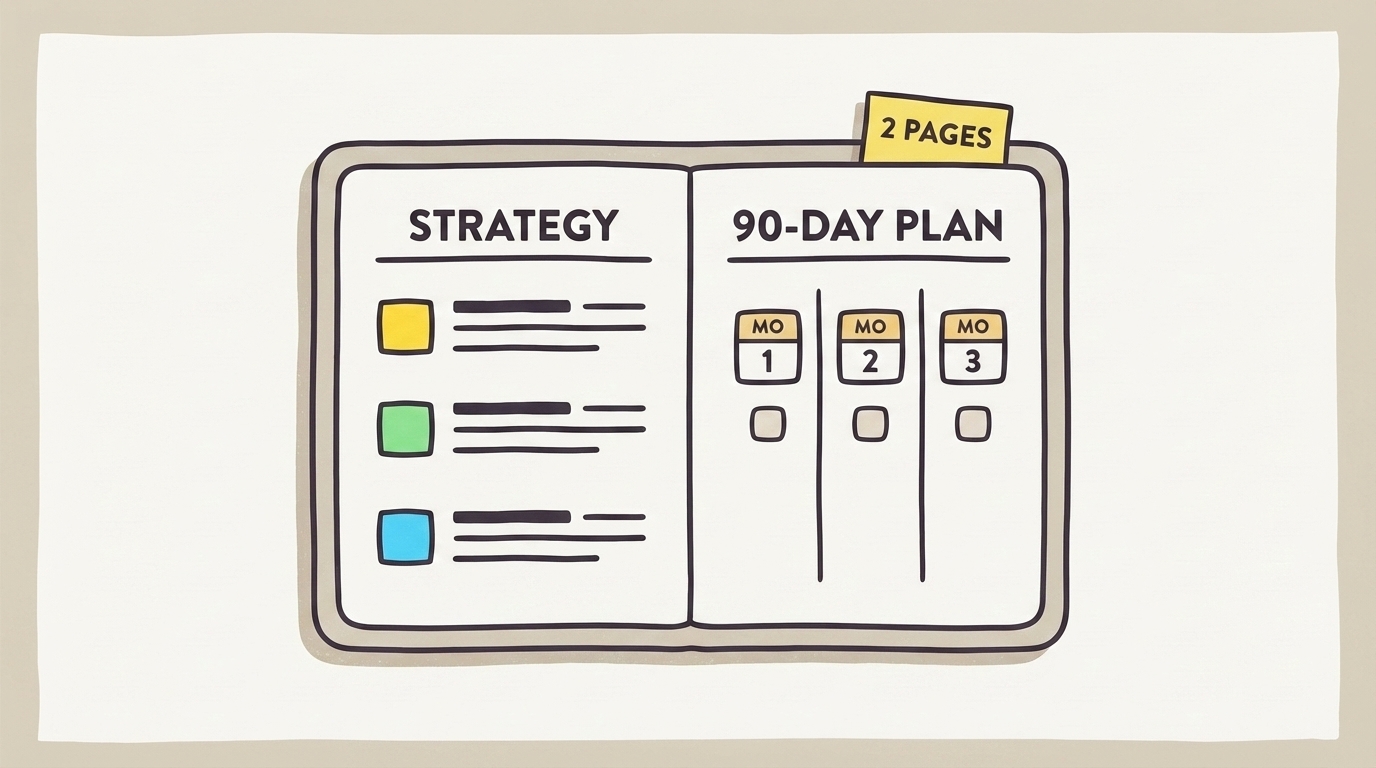
The document I hand clients after a 2-week assessment is 4-6 pages, not 60. The structure:
Page 1: The decision. One paragraph of context about the business, then the three recommended AI projects in priority order with one sentence of justification each. Then the one line that matters most: "If you can only do one thing in the next 90 days, do X."
Page 2: The opportunity map. The scored list of all 10-15 AI opportunities I found, ranked by "hours saved per week" and "time to set up." Each opportunity has a single sentence describing it, a rough time-saving estimate, and a rough setup effort. Clients use this as their backlog for the next 6 months. They pick off the next item whenever the previous one stabilizes.
Page 3: The first pilot detail. The workflow I recommend piloting first, in step-by-step detail. Which tool, the system prompt, the owner, the expected output, and the five test cases to run it against in week one. This is the only page of the document that's technical, and it's the only one that ships code to production.
Page 4: The 90-day plan. Month-by-month breakdown of what to tackle after the pilot lands. Not a project plan with Gantt charts -- just "month 1: ship pilot 1, train owner. Month 2: pilot 2 starts, pilot 1 maintenance. Month 3: pilot 3, review both previous pilots, decide whether to hire a dedicated AI ops person."
Optional page 5: Anti-recommendations. Sometimes clients ask me what not to do because they've been pitched something by a vendor. When they do, I add a page listing the 3-5 projects or tools I'd specifically skip and why. This is often the most valued page, because "don't buy X" saves more money than "buy Y" earns.
Optional page 6: Budget detail. Stack recommendations, seat counts, monthly costs, and a 12-month total. Only included if the client specifically asks for it (which smaller teams usually don't -- they know their own numbers).
Six pages max. Usually four. Everything else would be padding, and padding is what slideware vendors use to justify their fees.
The five red flags in an AI strategy consulting pitch
I've watched enough pitches from other advisors, boutique consultancies, and big firms to spot the patterns fast.
1. The word "transformation" appears in the first email. Transformation is a word that means "the project will take longer and cost more than you think." Real small-business AI work is a sequence of small workflow wins that together change how the team spends its time, not a transformation. If a consultant leads with transformation, they're running a different play.
2. The proposed engagement is longer than 3 weeks. For a 10-50 person company, there is no reason a strategy engagement should take longer than 2-3 weeks. Longer scopes are a sign the consultant is either inexperienced (doesn't know what to cut) or billing for bench time.
3. The output includes a "maturity model." Maturity models are the tell that the consultant has a templated deliverable they're adapting to you, rather than an original analysis of your business. If the slide exists before the engagement starts, you're paying for a fill-in-the-blanks exercise.
4. They insist on discovery before quoting. Good advisors can give you a rough price range in the first 20-minute call based on your team size, functions, and where you are with AI today. If a consultant won't quote until they've done "2-3 discovery calls," they're building the price up based on your apparent willingness to pay, not on what the work takes.
5. They don't use AI themselves, visibly. If the strategist writing your AI strategy isn't obviously using Claude or ChatGPT to draft their own emails, research your company, and build their own materials -- they're not a practitioner. They're selling a trend. You want advice from someone who types claude --model sonnet into their terminal ten times a day, not someone who read a McKinsey report last quarter.
What to ask on the first call
Six questions. Under 30 minutes. You'll know exactly what you're dealing with.
- "Based on what you already know about us, what are the three AI projects you'd prioritize first and why?" A real advisor will guess. A fake one will refuse without "more discovery."
- "Which tools would you use for each?" Opinions required. Hedges are a red flag.
- "What's your fixed fee for a 2-week engagement at our size?" No real number = no real package.
- "What's the smallest version of this that still delivers value?" Tests whether they know how to scope down.
- "What are you not going to do?" Good advisors have hard lines (I don't manage teams, run operations, or do ongoing implementation). Bad ones will say yes to everything.
- "Can I talk to one past client?" If the answer is "we're bound by NDAs on every engagement," the answer is a polite no. Ask anyway -- the way they handle the ask tells you more than the reference itself would.
A good consultant will pass all six in a first call. If they pass four, they're probably fine. If they pass two or fewer, keep looking.
What happens after the strategy is written
This is where most engagements fail, and it's worth spelling out so you plan for it.
A strategy document is not the goal. A running workflow is. If the consultant hands you the document and leaves, you have a 30-40% chance of shipping anything, based on the small-business rollouts I've watched. The number goes up to 80%+ if the engagement includes the first pilot.
Three ways to make sure the strategy turns into action:
1. Include the first pilot in the same engagement. My own 2-week assessment always ships a pilot in week two. If a strategy consultant offers you "strategy only" at a lower price, add $2K-$3K and get the pilot included. That tiny increase makes the strategy 2-3x more likely to stick.
2. Name the owner before the engagement ends. The document should include a specific person on your team as the owner of the first pilot. Not a role. A name. If you don't have that person identified by the end of week one, stop the engagement and figure out who it is first.
3. Schedule a 30-day review call. The consultant comes back for one hour at day 30 to look at what shipped, what didn't, and what to adjust. This should be included in the engagement fee, not a separate upsell. If you're quoted a fee without a 30-day follow-up, negotiate it in.
These three things, done together, push the odds of a strategy turning into running AI workflows from "coin flip" to "likely."
DIY vs hire: the honest answer
Do it yourself if:
- You're a founder or head of ops who already uses AI daily
- Your team is under 5 people
- You have one or two painful workflows and you can describe them in 2 sentences
- You have 2-3 weekends of focused time
Read how to implement AI in your business, run the AI readiness assessment on yourself, and skip straight to pilot work. You don't need a strategist -- you need to ship.
Hire a strategy consultant if:
- You're 10-50 people with multiple functions that want AI
- You've been paralyzed for 3+ months trying to decide what to do first
- Previous AI attempts failed and you can't tell if it was strategy or execution
- You have $5K-$10K available and you value speed over learning curve
- You want a short written document you can circulate internally
A good 2-week strategy engagement at $5K saves most small businesses 3-6 months of wandering, and the first pilot usually pays back the fee inside 60 days through time savings.
Getting help
If you want me to run a 2-week AI strategy engagement for your team -- strategy document plus first pilot shipped by day 14 -- book it here. I'll send a calendar link and a 10-minute intake form.
You can also read:
- AI consulting for small businesses -- the general version covering all flavors of consulting
- AI marketing consulting -- if your main pain is marketing team time
- How to implement AI in your business -- the DIY implementation framework
- The AI readiness assessment -- a 25-point scorecard to run on yourself before hiring anyone
- The best AI tools for small business in 2026 -- the tool picks referenced throughout this post
The core point: you only need AI strategy consulting when you genuinely can't decide what to do first and have 10+ people involved. If you can decide, skip the strategist and go straight to implementation. If you can't decide but you're small, read the four posts above and try the 4-phase framework yourself. Save the $5K. Ship your first pilot next month.
If neither of those works -- or you just want to compress months of decision paralysis into two weeks -- that's what a real AI strategy consultant is for.