If you run a small business and the words "AI consulting" make you picture a 40-slide deck, a six-figure contract, and a nine-month "digital transformation roadmap" -- I understand. That version exists. It's just not for you.
AI consulting for small businesses is a different animal. Short engagements. Real tools. Few meetings. Work that ships in weeks, not quarters. This post is a plain-English guide to what the good version looks like, what it should cost, and how to spot a bad one before you sign anything.
I write this from the other side of the table. I've run two-week AI audits for software teams, founders, and family-run companies with ten-person offices and no prior AI experience. The pattern is always the same: the business doesn't need an AI strategy, it needs one workflow unstuck, a tool picked, a person trained, and someone with taste to say "that's enough for now, ship it." The rest is noise.
What AI consulting for a small business is
Start with what it isn't.
It isn't a Fortune 500 engagement shrunk down. Those projects deliver 80-page strategy documents because the client has 4,000 people across 12 departments and a legal team that has to sign off before anyone touches anything. None of that applies to a 12-person agency or a 30-person SaaS company.
It also isn't a training course. If you just want to learn ChatGPT, take a $49 course. An advisor is for picking which workflows to fix and in what order, then making sure the fix happens.
What it is, when done well: a short, structured engagement where an outside operator looks at your business, finds the two or three workflows where AI will save the most time per dollar, picks the tools, writes the prompts, and gets one of them working before they leave. You end up with fewer meetings than you expected, one new habit your team uses, and a document you can hand to the next hire who asks "what are we doing with AI?"
The ingredients are simple:
- A process audit of how work currently flows through your business
- A prioritized list of AI opportunities scored by impact and effort
- Tool selection with real reasons (not "ChatGPT is popular")
- One working pilot, shipped and used by a real team member
- A written plan for the next three to six workflows
If your consulting engagement doesn't include all five, you're paying for slides.
Signs you are ready (and signs you're not)
Not every small business is ready for this, and a good advisor will say so before taking your money. The self-check:
You are ready if:
- You have at least one repetitive workflow that eats more than five hours a week of a real person's time. Weekly reports, sales follow-ups, support replies, onboarding emails, data entry, lead research -- any of these qualify.
- Somebody on your team already uses ChatGPT or Claude occasionally and likes it. You don't need an expert. You need one volunteer who isn't allergic to trying new things.
- You have a decision-maker (founder, owner, head of ops) who can say "yes, do it" without a committee.
- Your goals are measurable. "Cut time-to-first-response from four hours to under one hour" is measurable. "Become AI-powered" is not.
- You have a small budget for tools, usually between $50 and $500 a month, and you're willing to spend it on the right ones instead of a dozen free trials.
You are not ready if:
- You don't know what your team does all day. This is more common than you'd think. If you can't describe one person's Monday in specific tasks, don't hire a consultant. Hire a good ops person first.
- Your data is a disaster. If customer information lives across seven spreadsheets, three inboxes, and a notebook on somebody's desk, AI will not fix that. It will just automate the chaos faster.
- You're chasing the news cycle. "I read about agents and we need agents" is not a business problem. It's a headline anxiety.
- You can't commit a real human to owning whatever gets built. AI tools fail in small businesses 80% of the time because nobody owns them after the consultant leaves. No owner, no outcome.
If three or four of the "not ready" signs apply, fix those first. The best AI consulting engagement in the world won't save you from an owner who doesn't know what the team does.
What a typical engagement looks like
I'll describe the shape I use because it's the shape most small-business AI advisors converge on once they've been burned by 12-week projects. The name changes. The structure doesn't.
Call it a 2-week AI assessment.
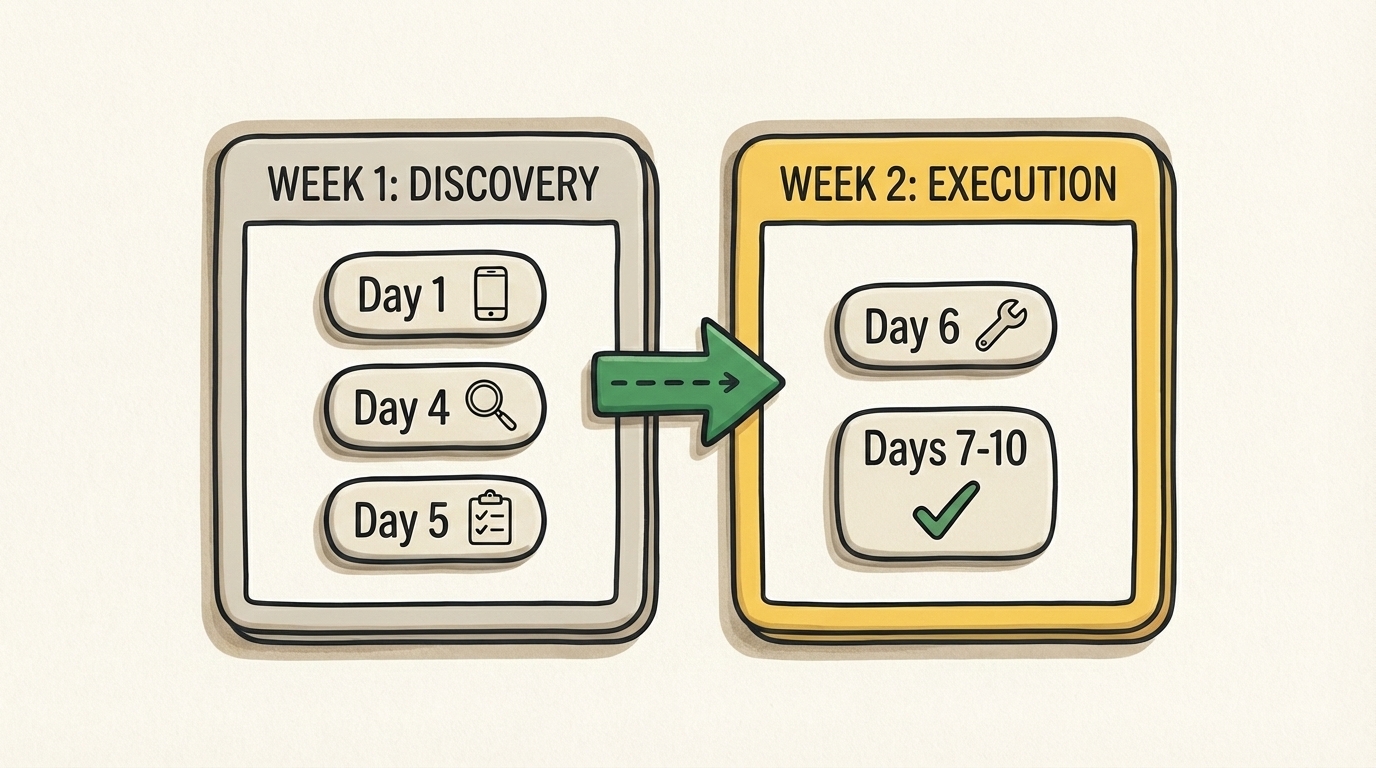
Week one is discovery. Two or three calls, each under an hour. You walk me through how your business makes money, who does what, and the workflows that hurt the most. I ask a lot of questions that feel basic: how many emails does your sales team send per week, how long does it take to draft a proposal, what happens when a support ticket comes in, who writes the monthly report. Basic questions surface obvious wins. I also look at the tools you already pay for, because half the time the AI feature you need is inside HubSpot, Attio, or Google Workspace and you're about to buy something that duplicates it.
By the end of week one I have a process map, a list of 10 to 15 AI opportunities with rough time-savings estimates, and a gut feeling for which workflow to fix first.
Week two is execution. We pick one workflow. Not three. One. I write the prompts, pick the tool, set up the accounts, train the owner, and watch it run through five real tasks. Something breaks. We fix it. Something else breaks. We fix that. By Friday the workflow is running, the owner knows how to maintain it, and we have a written playbook for the next two or three workflows we didn't get to yet.
At the end I hand over:
- A one-page executive summary of what I found and what we did
- The AI opportunities list, ranked
- Setup instructions for every tool you now use
- The prompts, saved somewhere you can edit them
- The 90-day plan for the next workflows
- A recorded walkthrough of the pilot in action
No 80-page deck. No "strategic framework." No architecture diagrams. Just the stuff you'll use.
The whole thing takes about 15 to 25 hours of my time and 8 to 12 hours of your team's time, spread across two calendar weeks. If somebody proposes the same scope over eight weeks, they're padding.
What AI consulting for small businesses costs
The real numbers, since nobody on the internet will tell you.
Hourly advisors: $150 to $400 per hour. You'll find former SaaS operators and ex-agency leads in this range. Useful if you know exactly what you want and just need someone to pair with you for a couple of calls.
Short fixed-fee engagements: $3,000 to $8,000 for a 2-week assessment like the one described above. This is the sweet spot for most small businesses. You know the price up front, the scope is small, and the advisor is incentivized to finish instead of dragging.
Retainers: $2,000 to $6,000 per month for ongoing "office hours" style advisory. Makes sense after an initial assessment if you want someone on call while you roll out the plan. Does not make sense as your first engagement -- you're paying for availability before you know what you need.
Full implementation agencies: $15,000 to $60,000+ for multi-week projects that include heavy build work. Only useful if you have no internal tech capacity and need someone to stand up an entire workflow end-to-end. For most small businesses this is overkill because the build work is 80% prompt writing and tool configuration, not code.
Enterprise "AI transformation" firms: $100,000 and up. Skip entirely if you have fewer than 100 employees. You are not their client. You are a warm lead for their next slide deck.
If a consultant can't give you a rough price in the first 20-minute call, they don't have a real package -- they have a custom-quote trap, and the number will move up based on how much they think you can afford. Walk away.
How to evaluate an AI consultant (red flags)
After three years of doing this work and watching peers do it, here are the patterns I trust and the ones I don't.
Trust these:
- They can name the specific tools they'd use on day one, with prices. A real advisor has opinions.
- They've run or worked inside a small business, not just consulted for one.
- They ask about the workflow, not the technology, in the first call.
- They're willing to be on the hook for one concrete outcome.
- Their contract fits on one page.
- They tell you what they won't do (my answer is always: team management, hiring, day-to-day ops).
Six questions that separate operators from deck sellers:
Ask these before you sign. You want a specific, immediate answer -- not a process description.
-
What exact workflow would you target first? If they say "it depends" before asking a single question about your business, walk away. A real operator has a hypothesis before the first call.
-
What software would you use for that? Name a specific tool with a price. "We'll evaluate options together" is stalling.
-
Who on my side must own this after you leave? If they don't ask this back, they've never actually tried to leave a working system behind.
-
What metric should move in 30 days? This separates people who've shipped things from people who've only advised on shipping. "We'll define success together" is not an answer.
-
What will you deliver by day 10 or 14? Not the final deliverable -- the midpoint checkpoint. Advisors who've done this know exactly what exists by day 10.
-
What will you not do? Scope discipline is a sign of experience. An advisor who says "anything you need" is either lying or about to scope-creep into a retainer.
If they answer all six cleanly in the first call, you found an operator. If they redirect or explain why the question is more complex than you think, you found a deck seller.
Red flags:
- The word "transformation" appears in the first email.
- They can't describe what they'll deliver without using the word "framework."
- Their pitch deck has a maturity model.
- They propose more than three meetings in week one.
- The price is "contact us" and won't firm up until after three discovery calls.
- They don't use AI themselves, visibly. If the advisor isn't writing their own emails with Claude, they're selling you a trend, not a tool.
- They refuse to run a pilot because "we need to assess readiness first."
That last one is the biggest tell. Readiness assessment is useful, but not as a stalling tactic. An advisor who can't ship a single workflow in two weeks probably can't ship anything.
DIY vs hiring an advisor
You don't have to hire anybody. The honest decision:
Do it yourself if:
- You have one or two repetitive workflows and somebody on the team who likes experimenting
- You're under five people total
- Your total AI budget is under $100 a month
- You're patient enough to spend a weekend writing prompts and watching YouTube
Start with my AI tools for small business post, grab the free AI starter kit, and run the 30-day plan from that post. You'll get 70% of what an advisor would deliver for $0, assuming you do the work.
Hire an advisor if:
- You have 10+ people and AI is now an "everyone's job" mess
- You've tried three tools already and nothing stuck
- The business has real cash and the time to not figure this out yourself is worth more than the fee
- You need an outside voice to tell your team what to stop doing
- You want a written plan you can hand to a future ops hire
A good advisor at $5,000 for two weeks of focused work will usually pay for themselves in the first month, because the "what to stop doing" list is worth more than the new tools. I've watched teams cut three SaaS subscriptions on the first call because the advisor noticed they were duplicating work an AI feature inside their existing CRM already did.
The 2-week AI assessment model in more detail
Since this is how I run my engagements, here's what happens hour by hour, so you know what "good" looks like before you buy it from me or anybody else.
Day 1 (90 min). Kickoff call. I ask how the business makes money, who does what, which tools you already pay for, and which workflows hurt the most. I also ask what you've tried with AI already so I don't repeat failed experiments.
Days 2-3 (async). I shadow your tools. Read onboarding docs, sample emails, support tickets, a few past proposals, the last month of marketing output. I'm looking for patterns -- the repetitive work that hides inside "creative" jobs.
Day 4 (60 min). Deep-dive call with the two or three team members closest to the painful workflows. I ask them, not the founder, how long each task takes and where it goes wrong.
Day 5 (async). I write up the opportunity map. 10 to 15 AI wins, scored on time saved per week and effort to set up, ranked by ratio. Send it over for a same-day reaction.
Day 6 (60 min). We pick one pilot. Not the most exciting one -- the one with the best ratio of impact to effort. Usually that's a content workflow, a sales follow-up workflow, or a support reply workflow.
Days 7-10 (build). I pick the tool, write the prompts, configure the account, and run it against five real cases from last week. Something breaks. I fix it. Repeat until it holds up. In parallel, I train the designated owner on how to run and maintain it.
Day 10 (60 min). Handoff call. Owner demonstrates the workflow to the founder. We agree on what "success" looks like for the next 30 days.
Day 11-14 (async). I write up the playbook, the 90-day plan, and a short Loom walkthrough of the pilot. Send the final package.
That's it. Total meeting time for your team: about 4 hours split across 2 weeks. Total work time for your team on the pilot: 6 to 8 hours. You end up with something running, not just documented.
Frequently asked questions
Will you run the workflow for us after the pilot?
No, and you don't want me to. The whole point is that your team owns it. If I become the dependency, I'm the new bottleneck and you just paid for a more expensive version of the problem you started with. I'll do a 30-day check-in and fix anything that broke, but I won't run it.
What if the pilot fails?
Then we write up why, pick the next workflow from the ranked list, and go again with the time left. In my experience 7 of 10 pilots work on the first try, 2 of 10 need a different tool or prompt, and 1 of 10 turns out to be a business problem that no AI can fix.
Can you guarantee ROI?
No. Anybody who does is lying. What a good advisor can guarantee is a working pilot at the end of the two weeks. The ROI depends on whether you stick with it.
Does my team need to know how AI works?
Not really. They need to know how to open the tool, enter the input, and judge if the output is good. That's it. The advisor handles the parts that need actual AI knowledge. If a consultant tells you your team needs a three-day training before you can even start, walk away.
How is this different from an IT consultant?
IT consultants fix infrastructure. AI consultants fix workflows. You might need both, but not from the same person.
What to do this week
If you're reading this because you're genuinely stuck on what to do with AI in your small business, try the smallest useful next step:
- Pick one workflow that takes more than five hours per week of somebody's time. Write down what it is, who does it, and how long it takes.
- Ask that person what they hate about it. The hate is where the AI opportunity is.
- Spend one hour trying to improve the workflow with Claude or ChatGPT. If it feels even a little easier, you already have your pilot.
- If that hour goes nowhere, or if you don't know which workflow to pick, or if your team has tried and bounced off AI three times already, that's when an outside advisor earns their fee.
If you want me to do the assessment, book a 2-week AI audit and I'll send you a calendar link and a short intake form. You can also read how I build AI systems for small teams, grab the free AI starter kit with the prompts I use every week, or browse the AI tools directory for honest reviews of every tool mentioned in this post.
The best small-business AI consulting isn't complicated. It's just somebody from outside your company who's paid to have strong opinions, do the boring setup work, and leave before they become a habit. If that's what you need, you now know exactly what to ask for.